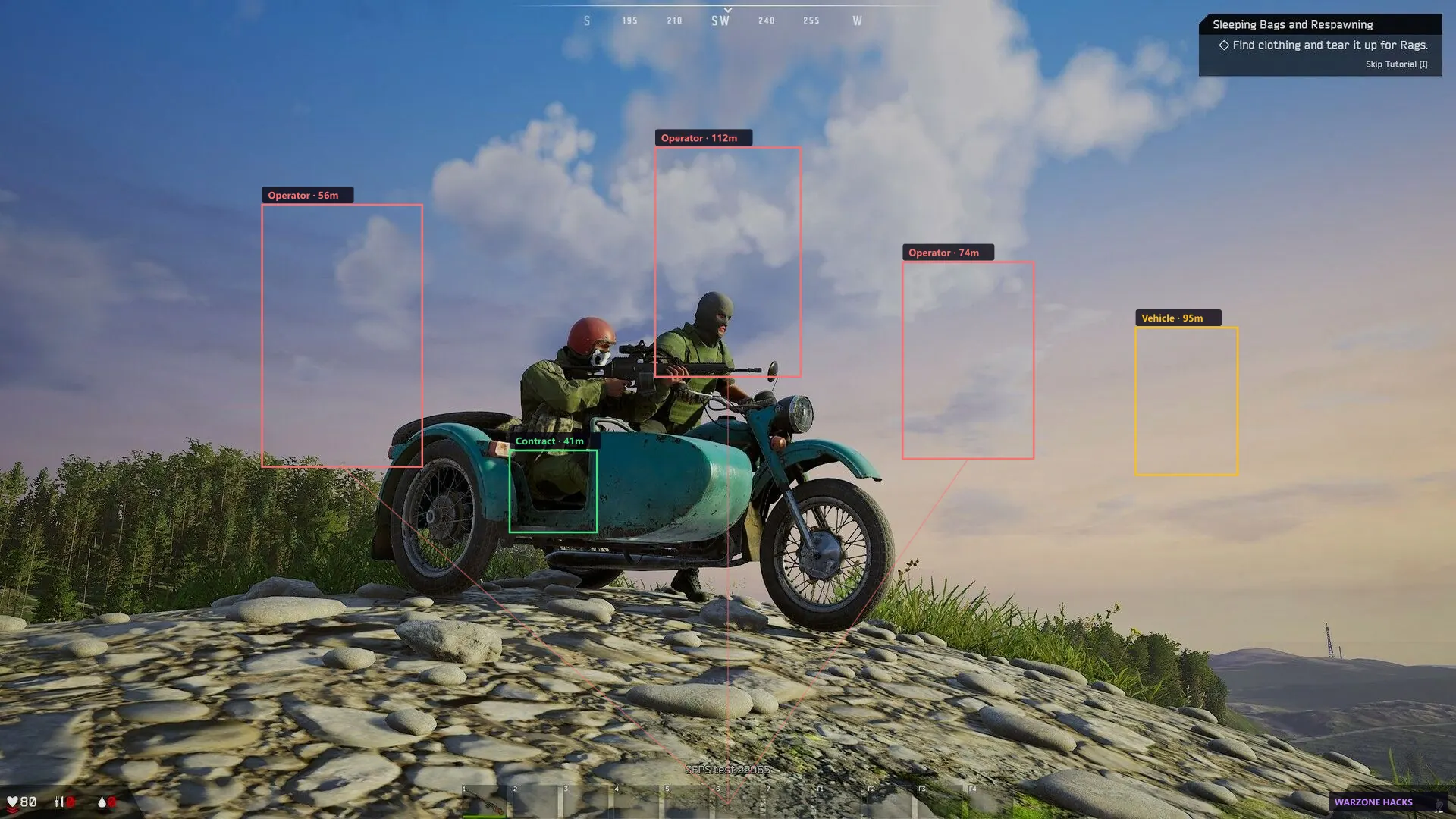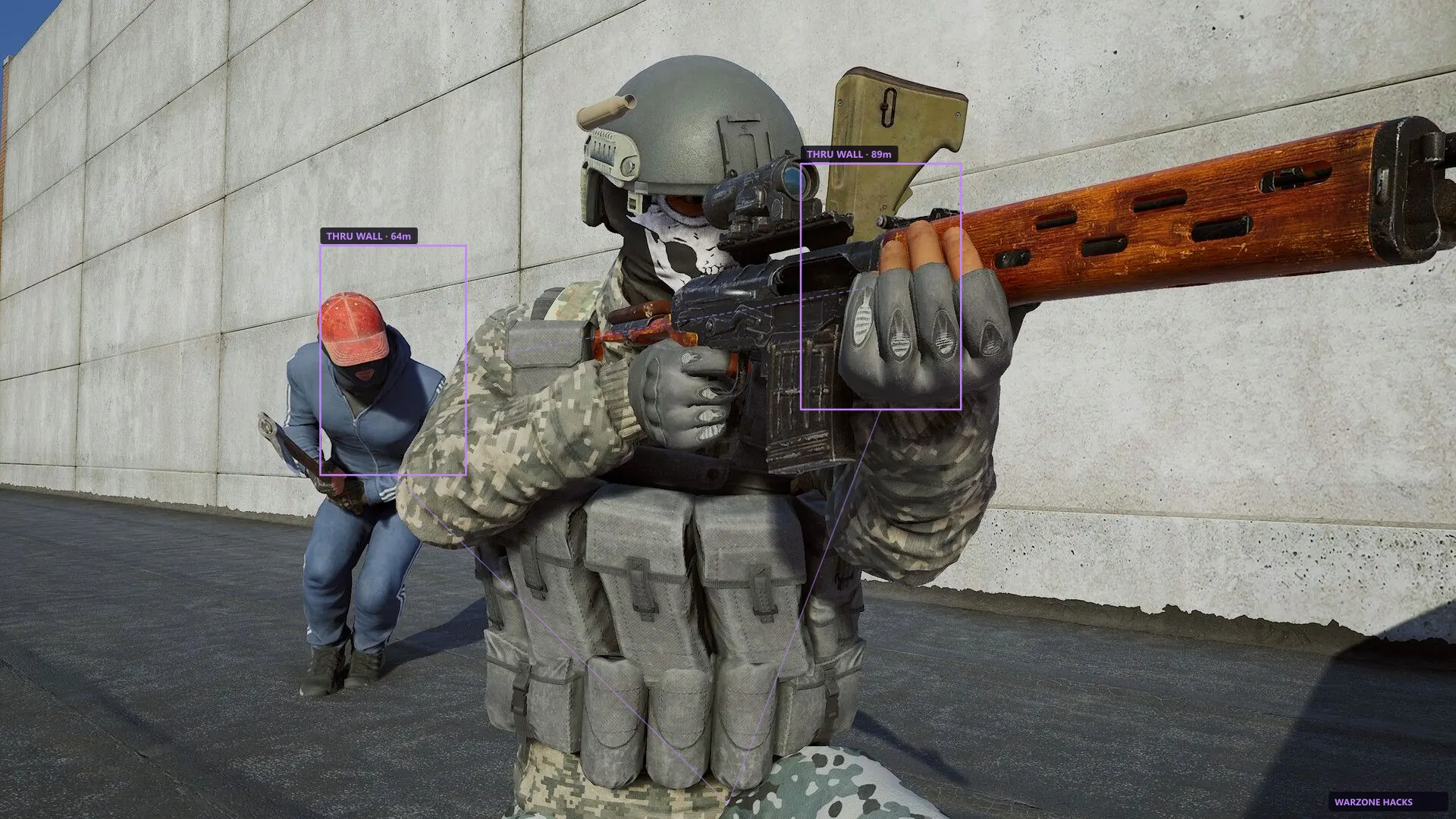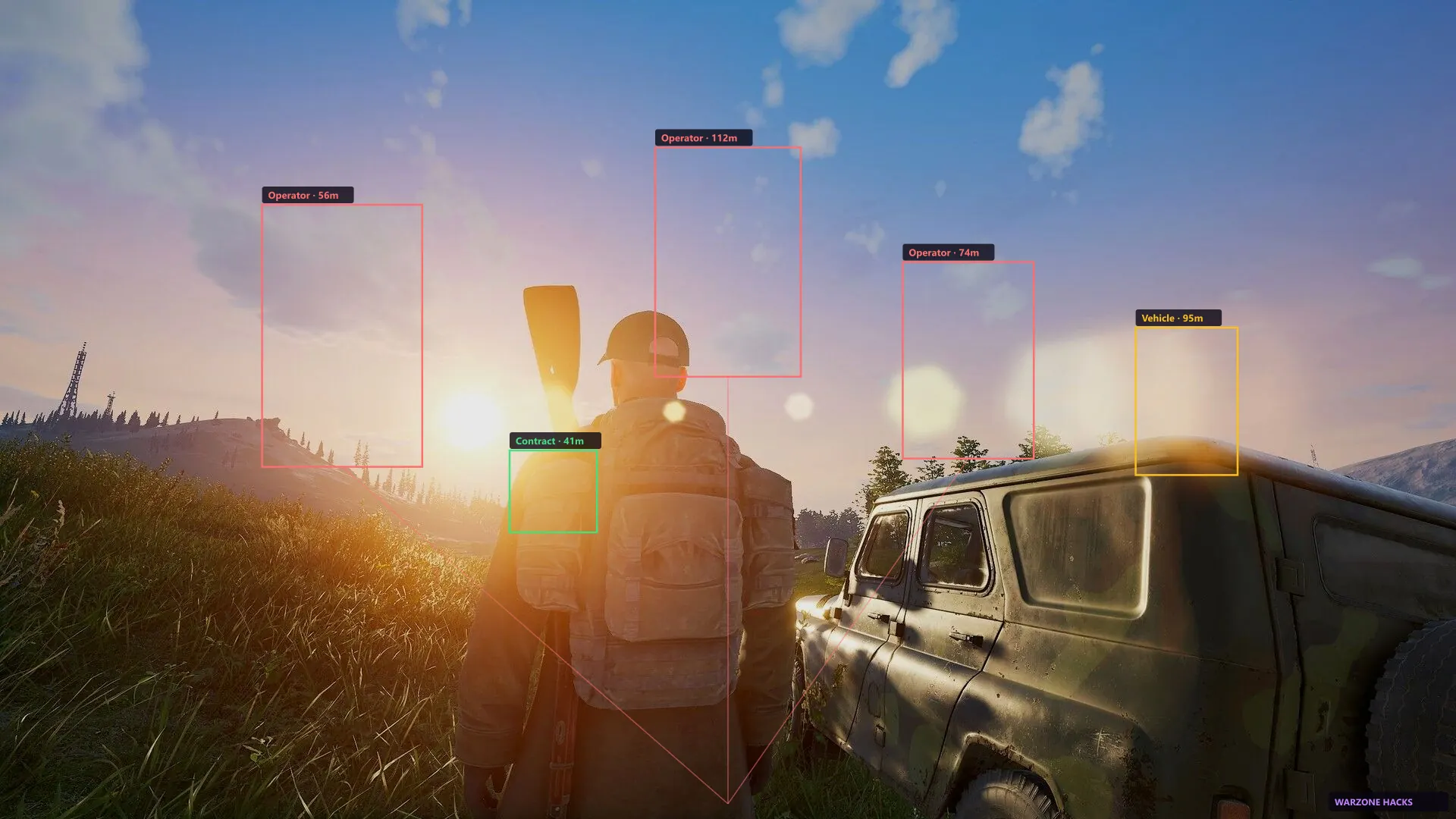
What ESP shows
Boxes, distance, and filters for players, NPCs, and loot. Each tracked object draws an outline you can see through terrain, with a number telling you how far away it is.
Distance is the part people underrate. A box on its own tells you something exists; a box with a range attached tells you whether it is worth reacting to. In practice you end up ignoring most of what the overlay draws and acting on the few things inside a range that matters.
- Player boxes with live distance
- Loot, crate, and military base markers
- NPC and vehicle highlighting
- Extract and vehicle direction cues
Filters and readability
Clear loot runs and PvP fights without flooding the screen. An unfiltered overlay in a busy loot run draws so many boxes that it actively hurts — you lose track of your own character among the outlines.
The fix is to enable only the categories that match the content. Farming loot runs for speed means loot and NPCs on, players off. Running a PvP fight means players on, loot off, so nothing competes with the mechanic you need to watch. Opacity is separate from filtering, and dropping it to roughly half is usually enough to keep the game readable underneath.
- Per-category toggles rather than one master switch
- Opacity control independent of filters
- Saved presets so you can switch content types quickly
Performance and frame rate
Drawing an overlay costs frames, and how many depends almost entirely on how much you ask it to draw. A filtered overlay tracking NPCs and loot in a loot run is cheap. An unfiltered one tracking every entity in a crowded hub is not.
If your frame rate drops noticeably, reduce what is being tracked before you reduce anything else. Turning off two categories you were not reading anyway usually recovers more performance than lowering game settings, and it makes the overlay easier to read at the same time.
Distance culling helps too. Capping the range at which boxes draw means the overlay stops rendering things far enough away that you were never going to react to them.
- Fewer enabled categories means fewer frames lost
- Distance culling stops far-away boxes rendering
- Lower opacity costs nothing in performance terms
ESP versus radar
These solve different problems and work best together. ESP tells you precisely what is in front of you, including through walls, which is what you want before you push a fight.
Radar tells you roughly what is around you, including behind you, which is what you want when something can approach off-screen. If you are choosing which to lean on, use ESP when you push and the radar overlay for general awareness. Our comparison of where ESP helps more than movement tools covers the trade-off in more depth.
- ESP — precise, forward, through-wall detail
- Radar — rough, all-round positional awareness
- Both included in the same licence
What ESP will not do for you
Seeing everything is not the same as playing well. The overlay tells you where things are; it does not tell you when to extract, which angle to hold, or whether your kit is worth the fight.
New players in particular tend to expect more than an overlay can deliver. If you are dying in open PvP, more boxes on screen will not fix bad positioning — you still need map flow and extract timing. What the overlay genuinely does is remove deaths caused by things you could not have seen.
It also will not replace a weak loadout. Faster looting only helps once you are surviving the run.
- Does not teach map flow or extract timing
- Does not compensate for undergeared kits
- Removes surprise, not difficulty
Next steps
ESP is included with aimbot and radar in one plan. There is no separate ESP-only licence, and no version of the plan where the overlay is limited.
If you push military bases often, the military base ESP guide is worth reading before your first session.